Cross-asset allocation research for global investors
AssetBuilding.org publishes research on global asset allocation. It connects the accumulation of savings and ownership with the later decision to invest capital across asset classes, regions and markets.
Global diversification begins with the purpose of the capital, the time available and the need for liquidity. It also depends on how an exposure is owned, how quickly it can be sold, what it costs and what risk it adds alongside existing holdings.
Readers can start with asset building, move to portfolio construction or use the research collection to examine the evidence behind both.
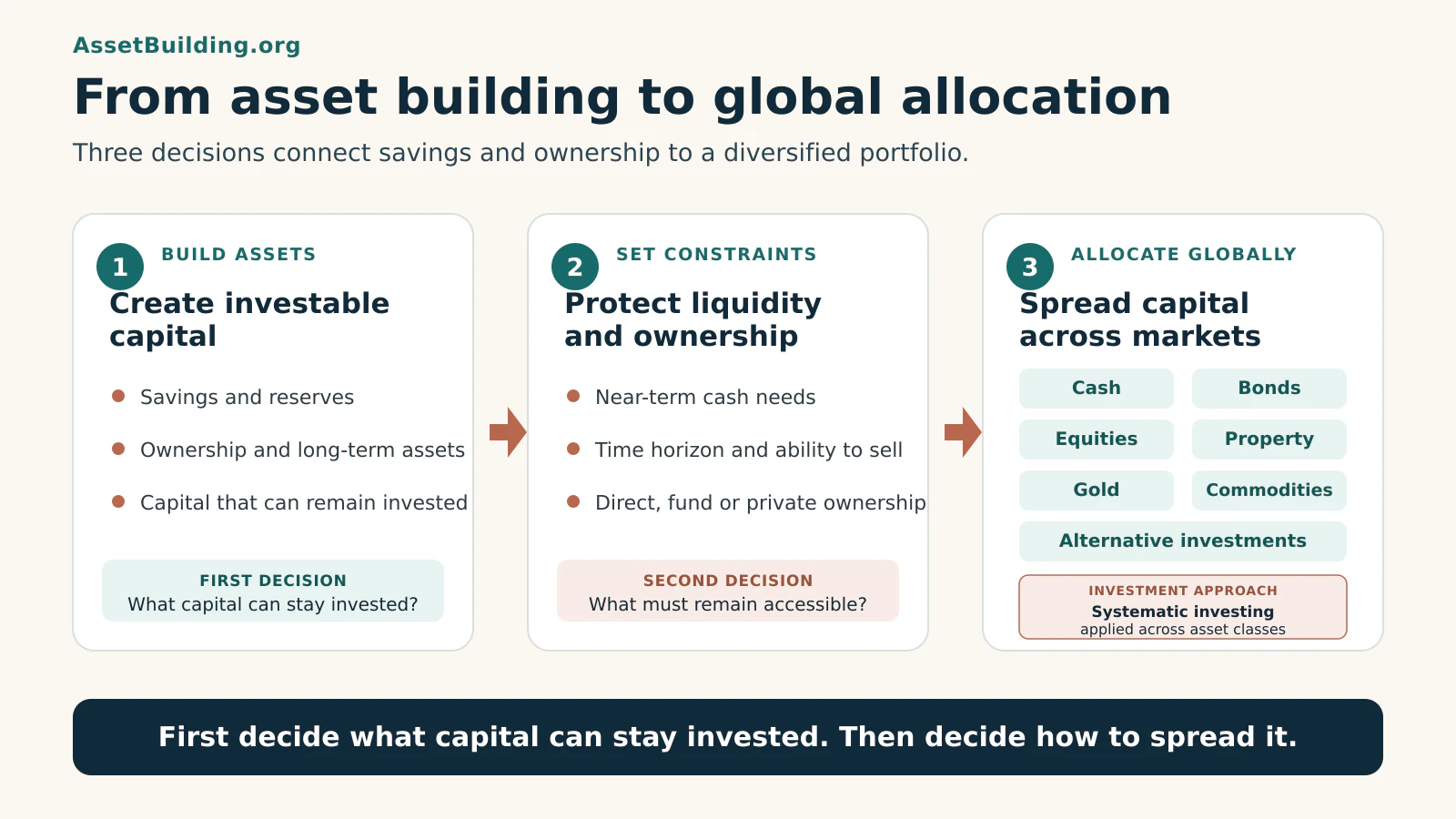
Why does asset building come before asset allocation?
Asset building comes first because money needed for near-term spending or emergencies has a different purpose from capital intended for long-term investment. Separating the two reduces the chance that an unexpected cash need forces the sale of a long-term holding at an unfavorable time.
Asset building can include savings, investments, a home, education, a business and retirement assets. Some assets provide liquidity. Others may support income, ownership or long-term financial security while being harder to sell.
Once enough capital can remain invested, asset allocation determines how it is divided across markets. Expected return matters, but so do price risk, income, inflation sensitivity, currency exposure, liquidity and concentration.
AssetBuilding.org over time
AssetBuilding.org has covered different parts of the capital-building process during its history. The current publication retains that continuity while concentrating on global asset allocation.
The dates describe changes in the publication’s scope. They do not claim that asset building itself followed one fixed historical sequence.
Where should readers start?
Start with the question that remains unresolved. Someone establishing savings and ownership has a different decision from an investor comparing asset classes or a researcher looking for policy evidence.
These subjects are connected. Asset building establishes available capital, portfolio building determines how it is invested, and research examines the evidence behind those decisions.
What does global asset allocation include?
Global asset allocation divides investment capital across asset classes and geographic markets while accounting for liquidity, risk, currency and ownership structure. The same asset can behave differently depending on whether it is held directly, through a public fund or through a private vehicle.
| Category | Typical portfolio use | Main risks or constraints |
|---|---|---|
| Cash | Near-term liquidity and capital stability | Inflation and limited long-term growth |
| Bonds | Income and possible diversification from equities | Interest-rate, inflation and credit risk |
| Equities | Ownership in companies and long-term capital growth | Market volatility, business failure and concentration |
| Direct property | Income, use value and real-asset exposure | Illiquidity, costs and location concentration |
| Gold | Real-asset exposure and possible diversification during periods of stress | Price volatility and no contractual income |
| Commodities | Exposure to energy, metals and agricultural prices | High volatility and costs that depend on the investment vehicle |
| Alternative investments | Exposure beyond listed equities, bonds and cash | Illiquidity, fees, valuation and legal structure |
| Systematic investing | Rules-based implementation across one or more asset classes | Model assumptions, data quality, trading costs and execution |
These uses are general. The actual result depends on the instrument, price paid, holding period, legal structure and the other assets in the portfolio. Diversification can reduce concentration, but it cannot remove investment risk.
Systematic investing is an investment approach rather than an asset class. It uses defined rules to select, size or trade positions across one or more markets. Current coverage concentrates on global asset allocation and asset building, with alternative investments and systematic methods reserved for focused future research.
Current research and restored resources
The current collection combines new editorial work with new pages that restore useful historical subjects. Dates and jurisdictions are stated so that an earlier policy or statistic is not presented as current evidence.
The homepage surfaces only a small selection. Each resource supports a broader asset-building or research subject.
Who publishes and updates AssetBuilding.org?
AssetBuilding.org is the publisher. The legal entity responsible for the site is THREE3, registration number 0808.276.848. Research and editorial work is attributed to the AssetBuilding Editorial Team. The site publishes informational research and does not provide personal investment advice.
Corrections and updates
The editorial team reviews sources, dates and material claims. A material correction will be made on the affected page and identified when the change alters the meaning of the published research. Older policy material remains dated and separate from current information.